
I Think We’re Alone Now
Architectural Association, Intermediate Unit 12 (2015–2016)

I Think We’re Alone Now explored architecture as a serial framework. Through research and design in Johannesburg, the unit examined how repetition, variation, and sequence could create adaptable systems for social and spatial transformation.

The third year of Intermediate 12 continued to investigate how architecture evolves through time, focusing on the idea of the series as both framework and method. The brief, titled I Think We’re Alone Now, explored how repetition, variation, and sequence could be used to test architectural adaptability. If the previous years had examined the event and the moment, this iteration asked how these could be extended across multiple sites, scales, and timeframes to form a coherent system of transformation.
Johannesburg provided the context for this exploration. The city’s fragmented urban condition, shifting communities, and simultaneous states of construction and decay offered a vivid ground for testing architecture as a responsive mechanism. The unit treated the city not as a fixed geography but as a dynamic environment defined by mutation and improvisation. Within this setting, students were asked to design five related spaces, a family of architectural moments, each responding to the city’s social and material complexity while contributing to a larger sequence of urban change.

The work unfolded through a structured series of investigations that developed the conceptual premise of serialisation into a working method.
Students began with collective research on the anatomy of events, producing an Event Archive Book that categorised case studies by their duration, structure, and social role. This exercise refined the tools inherited from previous years, expanding them into a taxonomy of time and behaviour. Each example was analysed for how it operated over time, what initiated it, how it grew, and what traces it left behind.
In parallel, students studied architectural precedents that embodied serial or sequential logic, from Baroque compositions and modular frameworks to contemporary digital processes. These references introduced the idea that architecture could be both ordered and open, capable of generating continuity through variation.
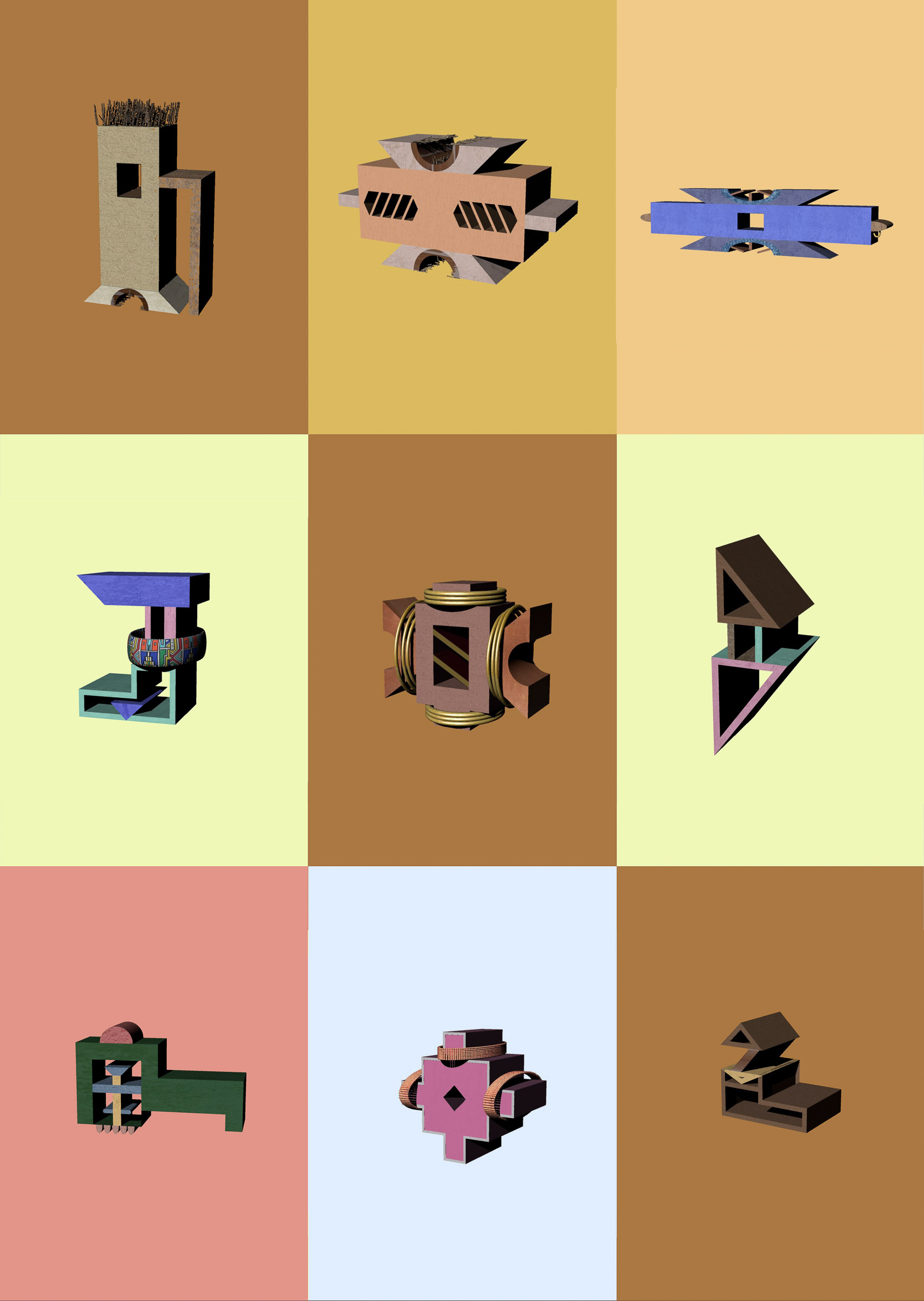
Building on this research, the design phase took place in Johannesburg. Each student identified a specific site and community to engage with, using it as a laboratory for experimentation. Projects began as small-scale provocations, temporary events, installations, or architectural scores, and expanded into a family of five interrelated interventions distributed across the city. The series became the project, each element autonomous yet connected, each responding to its own temporal and spatial conditions while contributing to a cumulative narrative.
Representation played a central role in articulating these relationships. Students developed time-based drawings and sequential models to express how their architectures evolved. Scores and diagrams described the rhythm of each moment, the transitions between spaces, and the projected futures of their proposals. A key part of the methodology was the one-to-one testing of ideas at the AA, where small constructed events were staged to explore the role of accident, humour, and failure as productive forces within the design process.

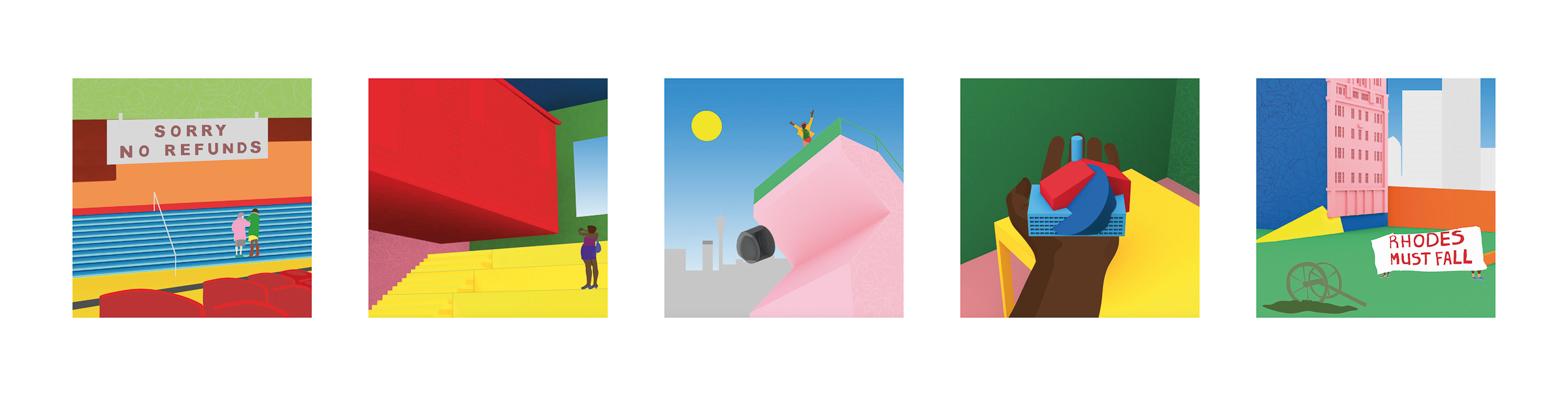
The final phase, titled The Future is Now, expanded these serialised projects to a city scale. Students speculated on Johannesburg’s urban future beyond 2030, transforming their sequences into larger frameworks for participation and transformation.
I Think We’re Alone Now consolidated the first three years of Intermediate 12 into a mature and adaptable methodology. The work demonstrated that architecture can evolve through sequence, that continuity can emerge from difference rather than uniformity. By treating serialisation as both structure and attitude, the unit revealed how architecture might sustain relevance through change, allowing form, use, and meaning to shift without losing coherence.

The Johannesburg context made this inquiry tangible. It showed that adaptability is not only a technical or aesthetic quality but a social one, the ability of architecture to remain open to new uses, communities, and circumstances. Through the design of families, scores, and series, students learned to see architecture as an ongoing project rather than a finite result.
This third year marked a point of synthesis in the studio’s evolving research. The language of time, event, and participation introduced in earlier briefs was now formalised into a system of practice, architecture as a sequence of actions that continues to adapt long after its initial form is complete.


Contact
First Phase
First Phase diagnostic.